Habits9 min read
How to start a food diary: a 7-day plan for beginners
Most food diaries are abandoned by day four because day one asked for too much. Here's what to write down, a seven-day plan that adds one small step at a time, and the mistakes that quietly end diaries early.
On this page
Most food diaries don't fail on day thirty. They fail on day four, usually around dinner, when logging every gram starts to feel like a second job. That isn't a discipline problem. It's a design problem: day one asked for too much. Here's a week that asks for a little less, and keeps you going.
To start a food diary, don't log everything on day one. Log one meal, then add one small habit a day for a week: a hunger check-in, a second meal, your mood, a faster way to log, one complete day, and a look back on day seven.
- Write down: what you ate, roughly how much and when. Add hunger (1–10) and one feeling word if you can.
- Aim for: logging often, not perfectly. Research links the frequency of logging with results more than the time spent on it.3
- Missed a day? Pick up at the next meal. Just try not to miss two in a row.
Why keep a food diary at all?
A food diary is the simplest nutrition tool there is, and one of the best studied. Writing down what you eat turns a blur of meals and snacks into something you can actually look at. In one large weight-loss trial with nearly 1,700 adults, the number of food records people kept was among the strongest predictors of how much weight they lost.1 A systematic review of 22 studies found the same pattern across the board: self-monitoring and results go together, although the authors were careful to call the evidence promising rather than conclusive.2
But a diary isn't only for weight loss. It's how you find out that your energy dips on days you skip breakfast, that the 4 pm snack follows a stressful meeting, or that you feel best after meals you hadn't even noticed you liked. Weight is one thing a diary can help with. Understanding yourself is the bigger one.
What to write in a food diary
Start with the essentials and add the extras when they feel easy. You don't need everything from the first meal.
| What to note | Example | Why it helps | Start hereEssential? |
|---|---|---|---|
| What you ate | Oat porridge, blueberries, coffee with milk | The raw material for every pattern | Yes |
| Roughly how much | A medium bowl, a handful | Close enough is good enough | Yes |
| When | 7:40, before work | Shows gaps, late meals and grazing | Yes |
| How hungry you were | 3 out of 10, properly hungry | Separates hunger from habit | From day 2 |
| One feeling word | Rushed, calm, bored, happy | Reveals emotional triggers | From day 2 |
| Where and with whom | At my desk, alone | Context explains a lot | Optional |
| Calories and macros | 420 kcal, 14 g protein | Useful for specific goals | Optional, an app does the maths |
Calories are optional. If numbers make you anxious, see how to track food without counting calories.
The 7-day plan: one small step a day
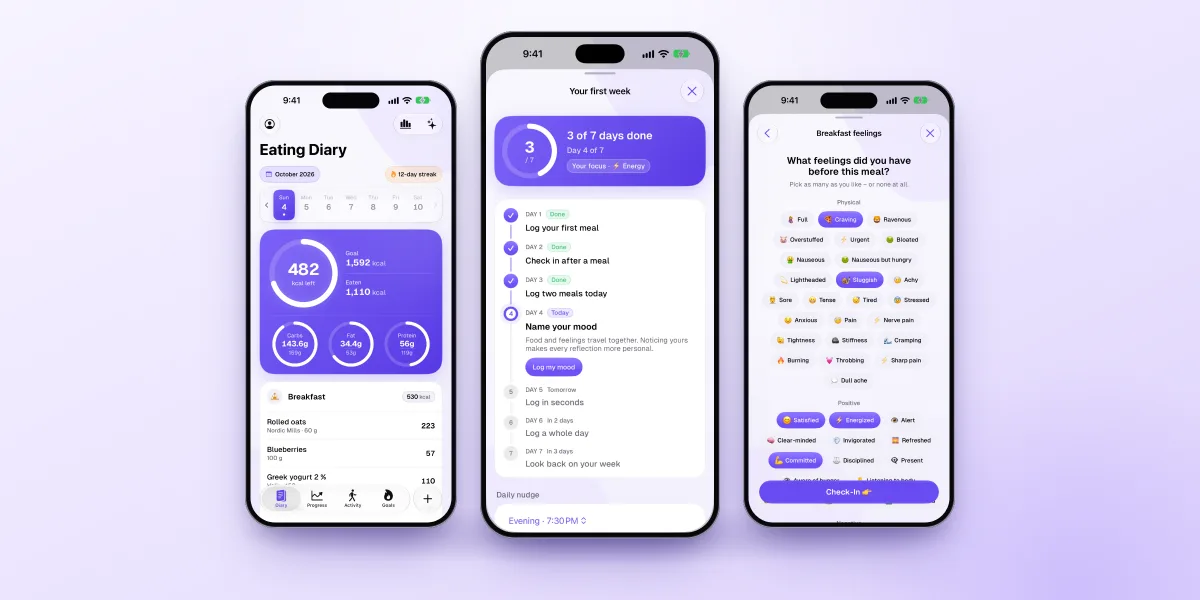
Each day adds one thing that takes under a minute. By the end of the week you'll have a full picture without ever having had a hard day of logging. This is the same plan Fimbl's guided First Week walks you through, but it works just as well with a notebook.
- Day 1: Log one meal. Anything counts: a coffee, a snack, a full plate. The only goal is to start, so pick the easiest meal of your day and write it down. Close enough is good enough.
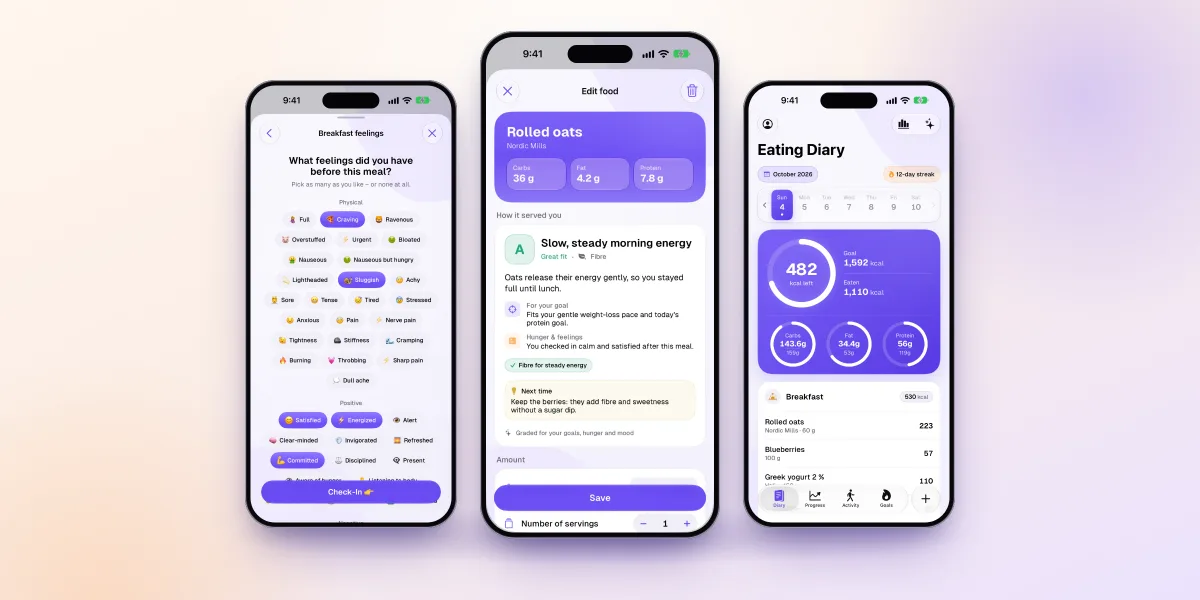
- Day 2: Check in after a meal. Log a meal, then add two things: how hungry you were before (1 to 10) and how you feel now. Awareness comes before change, and this is where awareness starts.
- Day 3: Log two meals. One meal is a moment. Two start to show a pattern: how long between them, how hungry you were at the second, what you reached for.
- Day 4: Name your mood. One word for the day as a whole. Food and feelings travel together, and naming yours makes every look back more personal. There are no wrong answers.
- Day 5: Make it effortless. Find your fastest way to log: a barcode scan, a saved meal, a quick add of a rough calorie number, or a photo. The easier logging feels, the longer you'll keep it up.
- Day 6: Log one whole day. Every meal and snack, from morning to night, just this once. Seeing the full picture of an ordinary day is surprisingly eye-opening.
- Day 7: Look back on your week. Read your week from start to finish. What surprised you? When were you hungriest? Which meals left you feeling good? Pick one small thing to try next week.
Missed a step? Catch up, don't start over. If day 3 slips by, do it on day 4 alongside that day's step. Restarting from zero is what turns one missed day into a lost week. The rule we print right in the app: miss a day, that's fine. Just don't miss two.
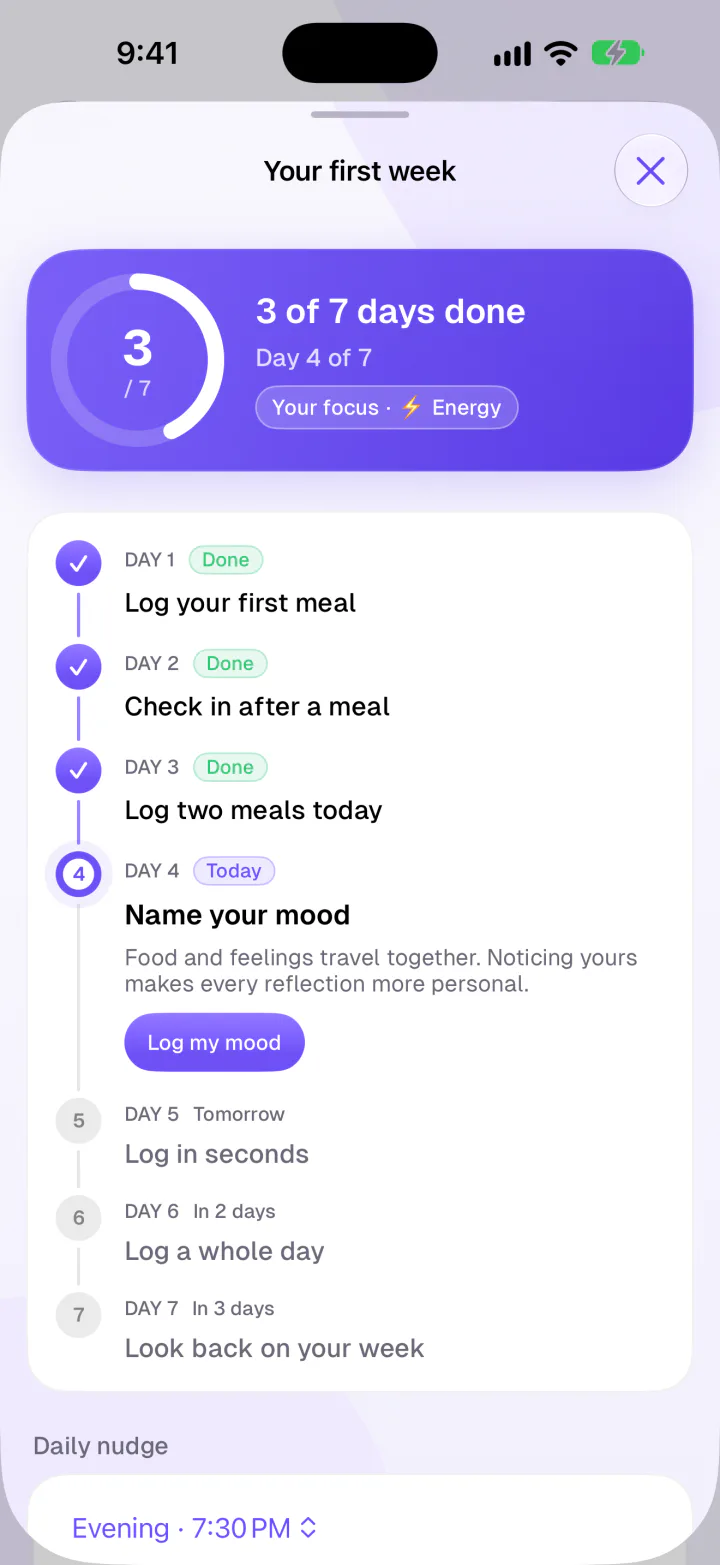
- One action per day, each under a minute
- Skip it or replay it any time from Settings
Paper, notes app or food diary app?
The best food diary is the one you'll actually open on a busy Tuesday. Each format has its strengths:
Paper or notes app
- Great for
- Total freedom, no setup, nothing to learn and nothing to install.
- Harder at
- Spotting patterns. You do all the digging, and it's easy to forget the hunger and feelings part.
- Best if
- You only want a short experiment, or numbers aren't part of your goal at all.
A food diary app
- Great for
- Speed: search, barcode scanning, saved meals and reminders make each log take seconds.
- Harder at
- Some apps only count. Pick one that also asks how you felt, or the most useful half of the diary goes missing.
- Best if
- You want to keep going past the first week and see trends without doing the maths.
If you go the app route, our comparison of calorie tracker apps covers what each one does for free, and which ones skip the ads.
-
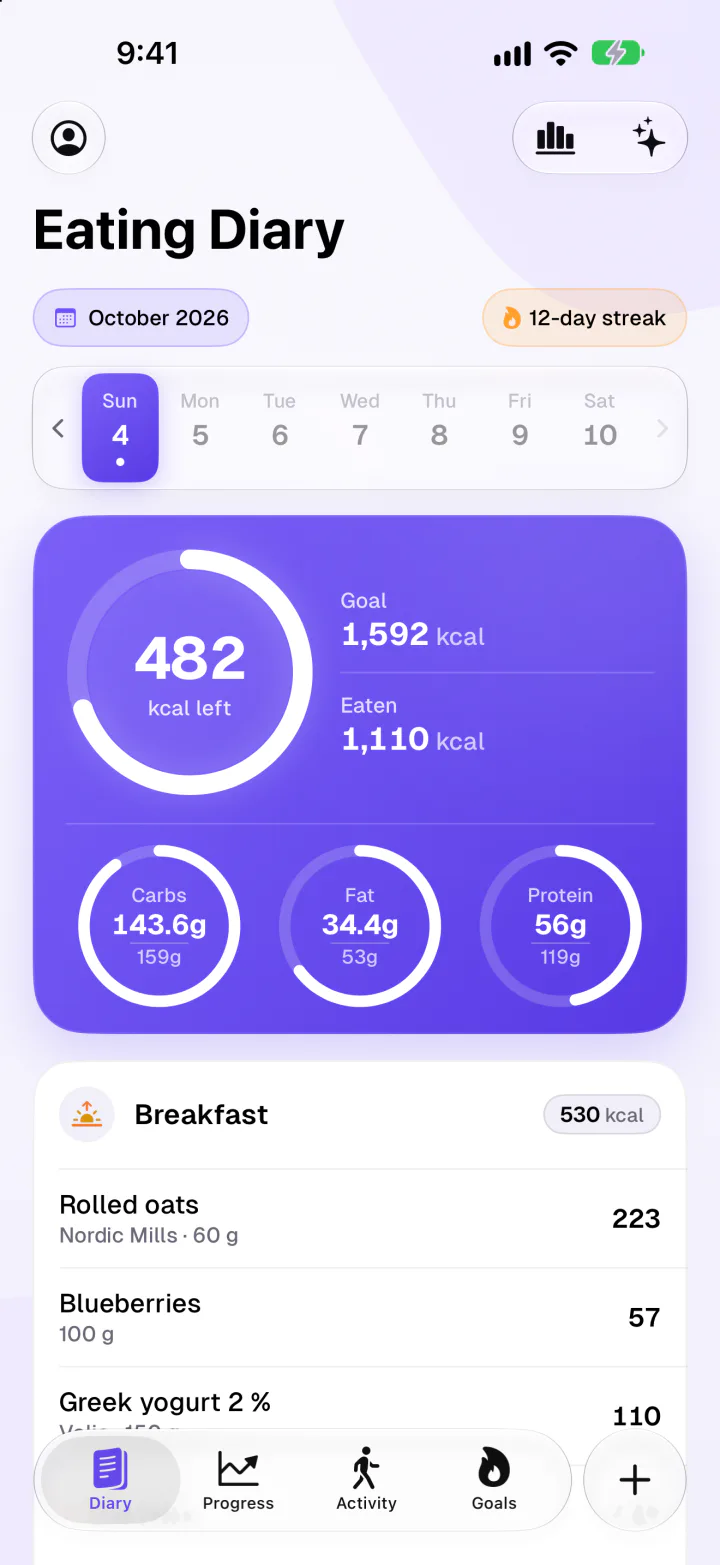
A diary that stays quickSearch by name or brand, scan a barcode, or re-log a saved meal with one tap. All free.
-
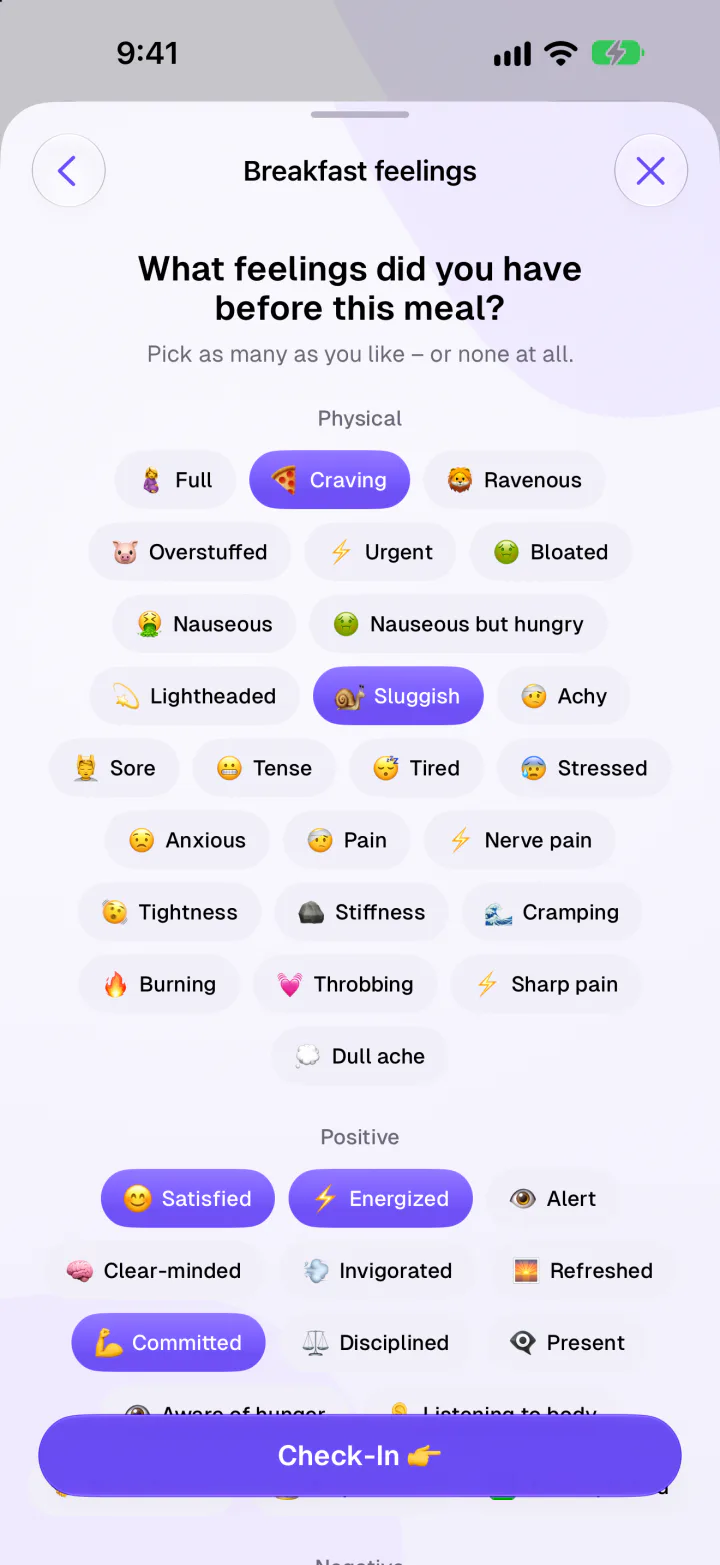
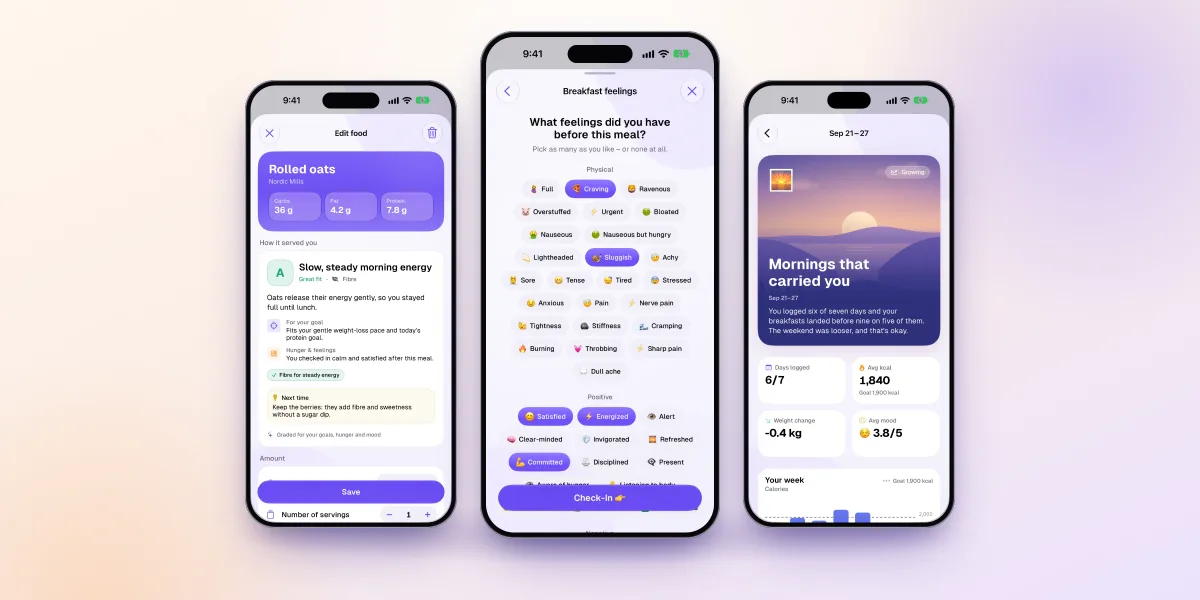
The half most diaries skipHunger and feelings at each meal, in about ten seconds. Also free.
Five mistakes that end food diaries early
- Logging at the end of the dayBy evening, lunch is a guess and the afternoon snack is gone from memory. Log right after you eat, or at least before the next meal.
- Chasing perfect accuracyWeighing every gram is exhausting. Consistent rough estimates tell you far more than a perfect week followed by nothing.
- Skipping the "bad" mealsThe takeaway and the biscuits are the most useful entries in the diary. Leaving them out only hides the pattern you're looking for.
- Restarting after a gapA missed day isn't a failed diary. Pick up at the next meal, without trying to backfill or make up for anything.
- Never looking backA diary nobody reads is just data. Ten minutes once a week is when the patterns, and the motivation, show up.
After week one: what to look for
The first week is about the habit. From week two, the diary starts paying you back. When you look back, try these three questions:
- WhenAre there long gaps followed by very hungry meals? Regular meals make calm eating much easier.
- WhyWhich feelings show up before the meals you didn't plan? Stress, boredom and tiredness are the usual suspects.
- HowWhich meals left you full and energised for hours? Those are worth repeating on purpose.
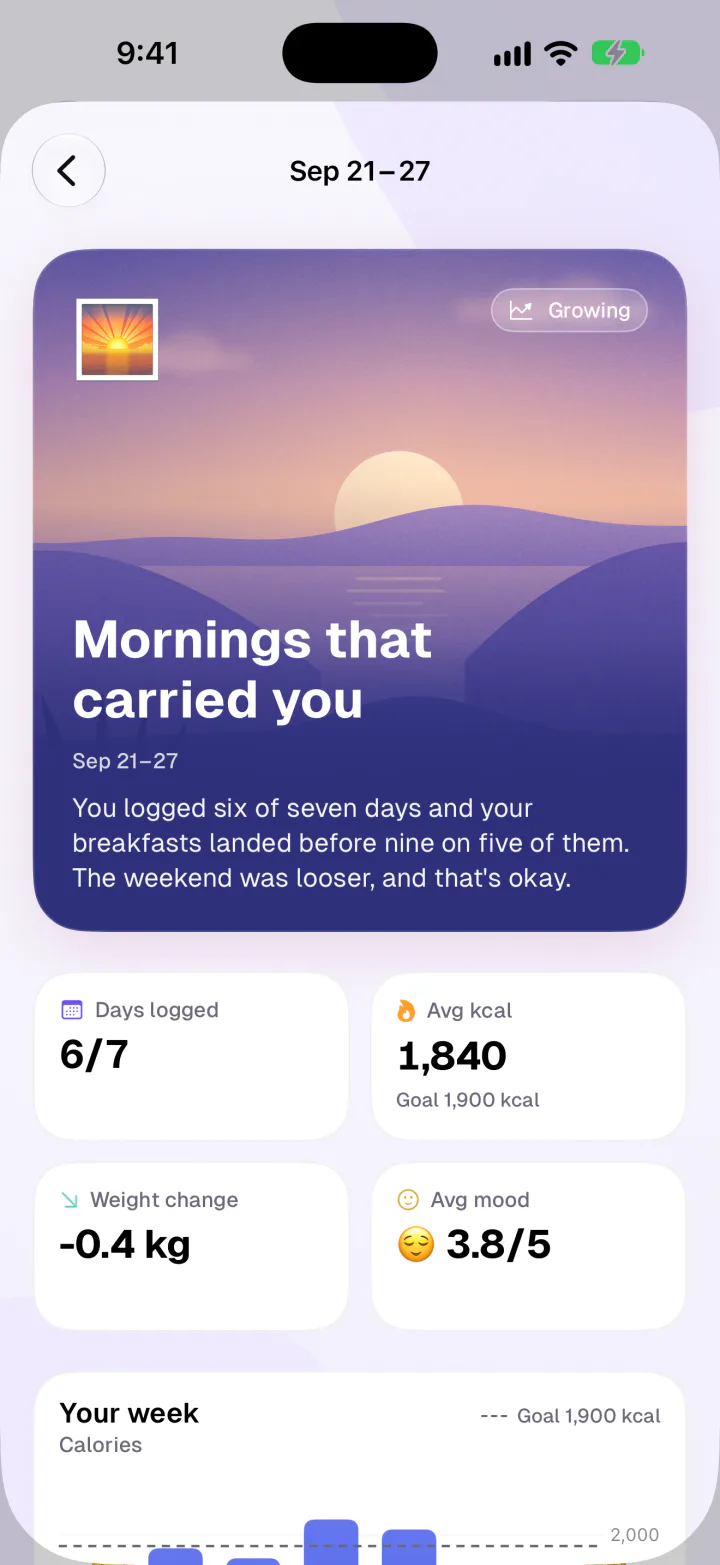
If a feeling keeps showing up before snacks, our guide to emotional vs physical hunger walks through what to do with it. And don't be surprised if it takes a few weeks for patterns to stand out. In one study of an online programme, the time people needed for logging fell from about 23 minutes a day in the first month to under 15 by month six.3 It gets easier.
When a food diary isn't a good idea
For most people a food diary is a helpful, low-stakes tool. For some, it isn't. Research has linked calorie tracking with eating-disorder symptoms in some groups: in one study of people with eating disorders, most of those who used a calorie-tracking app felt it had contributed to their symptoms.4, 5
If you have a history of disordered eating, or tracking makes you anxious, guilty or rigid about food, talk to a doctor or dietitian before you start, and stop if it feels worse rather than better. Fimbl is a food diary, not a medical tool or a treatment for eating disorders.
One meal is enough for day one
Fimbl's free First Week guides you through all seven steps with one gentle nudge a day. No ads, no streak shame, and catch-ups whenever life gets in the way.
- Free diary, barcode scanner and check-ins
- A guided first week, one minute a day
- English, German and Finnish
Questions, answered
What should I write in a food diary?
Start with three essentials: what you ate, roughly how much, and when. Once that feels easy, add how hungry you were on a scale of 1 to 10 and one word for how you felt. Calories and macros are optional; an app can work them out for you.
How long should I keep a food diary?
Give it at least one full week to build the habit, then two to four weeks to see patterns. Many people keep going for months because it becomes quick and useful, but even a short diary can show you a lot about your eating.
Do I have to count calories in a food diary?
No. A food diary can be as simple as what, when and how you felt. Calories are useful for some goals, but plenty of people get most of the benefit from noticing patterns alone. Fimbl's Calm mode (Premium) even replaces calorie numbers with gentle grades.
Is a food diary app better than paper?
Neither is better in general. Paper is flexible and has no setup. An app is faster thanks to search, barcode scanning and saved meals, sends reminders and shows trends for you. The best choice is the one you'll keep opening.
What if I forget to log a meal?
Log what you remember, or simply carry on from the next meal. A missed meal or day doesn't ruin a diary; trying to start over from scratch is what usually ends it. A helpful rule is: miss a day if you have to, but try not to miss two.
Does keeping a food diary help with weight loss?
Research consistently links food logging with better weight-loss results, especially logging often and consistently. In a trial of nearly 1,700 adults, the number of food records kept was among the strongest predictors of weight lost. The evidence shows a strong association rather than proof for every individual.
Is there a free food diary app with a guided start?
Yes. Fimbl for iPhone and iPad is free to download and includes a guided First Week: seven days, one small step a day, with a reminder at the time you choose. The diary, barcode scanner and meal check-ins are free and have no ads.
Sources
- Hollis JF et al. (2008). Weight loss during the intensive intervention phase of the weight-loss maintenance trial. American Journal of Preventive Medicine 35(2). pubmed.ncbi.nlm.nih.gov
- Burke LE, Wang J, Sevick MA (2011). Self-monitoring in weight loss: a systematic review of the literature. Journal of the American Dietetic Association 111(1). pubmed.ncbi.nlm.nih.gov
- Harvey J et al. (2019). Log often, lose more: electronic dietary self-monitoring for weight loss. Obesity 27(3). pubmed.ncbi.nlm.nih.gov
- Levinson CA, Fewell L, Brosof LC (2017). My Fitness Pal calorie tracker usage in the eating disorders. Eating Behaviors 27. pubmed.ncbi.nlm.nih.gov
- Simpson CC, Mazzeo SE (2017). Calorie counting and fitness tracking technology: associations with eating disorder symptomatology. Eating Behaviors 26. pubmed.ncbi.nlm.nih.gov