Mindful eating8 min read
Emotional hunger vs physical hunger: how to tell the difference
Seven signs that separate the two, a simple 1 to 10 hunger scale and a ten-second check-in you can use before any meal. No willpower lectures, just a clearer read on what you actually need.
On this page
- What is emotional hunger?
- Physical vs emotional hunger: 7 signs that tell them apart
- Use a hunger scale: rate it from 1 to 10
- A ten-second check-in before you eat
- What to do when the hunger is emotional
- Why noticing works better than willpower
- Tools that help you notice, compared
- When to get support
- Questions, answered
Four in the afternoon. You had lunch two hours ago, you're not exactly hungry, and yet here you are, standing at the snack cupboard. That pull is worth understanding rather than fighting. Emotional hunger isn't a lack of willpower. It's information about how your day is going.
Physical hunger builds slowly, shows up in your body, can wait a little, is happy with many foods and fades when you're full. Emotional hunger arrives suddenly, lives in your head, feels urgent, wants one specific food and often carries on past full.
- Quick test: if you ate a few hours ago and your stomach isn't rumbling, you're probably not physically hungry.1
- Then: rate your hunger from 1 to 10 and name the feeling in one word. That ten-second pause is often enough to choose on purpose.
What is emotional hunger?
Emotional hunger is the urge to eat in response to a feeling rather than a physical need for energy. Stress is the classic trigger, but it isn't the only one. Boredom, loneliness, tiredness, feeling rushed, wanting a reward or simply being around other people who are eating can all set it off. Even good feelings count: celebration is one of the most common reasons we eat when we're not hungry.
Almost everyone eats emotionally sometimes, and that's fine. Food is comfort, culture and connection. It becomes worth a closer look when eating turns into your main way of handling feelings, or when it leaves you feeling worse than before.2
Physical vs emotional hunger: 7 signs that tell them apart
| Sign | Physical hunger | Emotional hunger |
|---|---|---|
| 1. How it starts | Gradually, over a few hours | Suddenly, often right after a trigger |
| 2. Where you feel it | In your body: rumbling stomach, low energy, poor focus | In your head: a thought, an image, a craving |
| 3. Urgency | It can wait twenty minutes | It feels like it has to happen now |
| 4. What you want | Open to many foods, even a plain sandwich | One specific food, often sweet, salty or crunchy |
| 5. Timing | Usually a few hours since you last ate | Any time, even straight after a meal |
| 6. When it stops | When you're comfortably full | Often not until you're past full |
| 7. Afterwards | Satisfied and steadier | Guilt, or the feeling is still there |
No single sign is proof. A long, stressful day can leave you both genuinely hungry and emotionally drained. The point isn't to sort every bite into a box. It's to notice which one is louder right now.
Use a hunger scale: rate it from 1 to 10
A hunger scale turns a vague feeling into a number you can check in seconds. Versions of it are widely used in mindful and intuitive eating. It isn't a test you can fail. It's a way of listening.
How hungry am I, right now?
- 1
- 2
- 3
- 4
- 5
- 6
- 7
- 8
- 9
- 10
If you're at 5 or above and still want to eat, the urge is probably coming from somewhere other than your stomach. That's useful to know, not a reason to say no.
Waiting until you're at 1 or 2 tends to backfire. When you're ravenous, it's much harder to eat calmly, so regular meals are one of the simplest ways to make emotional eating less likely.
A ten-second check-in before you eat
You don't need a journal or a meditation app. Before you reach for food, run through this:
- Pause for one breath. Just enough to step out of autopilot.
- Rate your hunger. Somewhere between 1 and 10, using the scale above. A rough guess is fine.
- Name the feeling in one word. Stressed, bored, lonely, tired, anxious, rushed, happy. Naming it often takes some of the urgency out of it.
- Check HALT. Am I hungry, angry, lonely or tired? The slogan comes from addiction-recovery communities, and it's a handy shortcut for spotting needs that food can't meet.6
- Choose kindly. Eat and enjoy it, wait ten minutes, or give yourself what you actually need. All three are good answers.
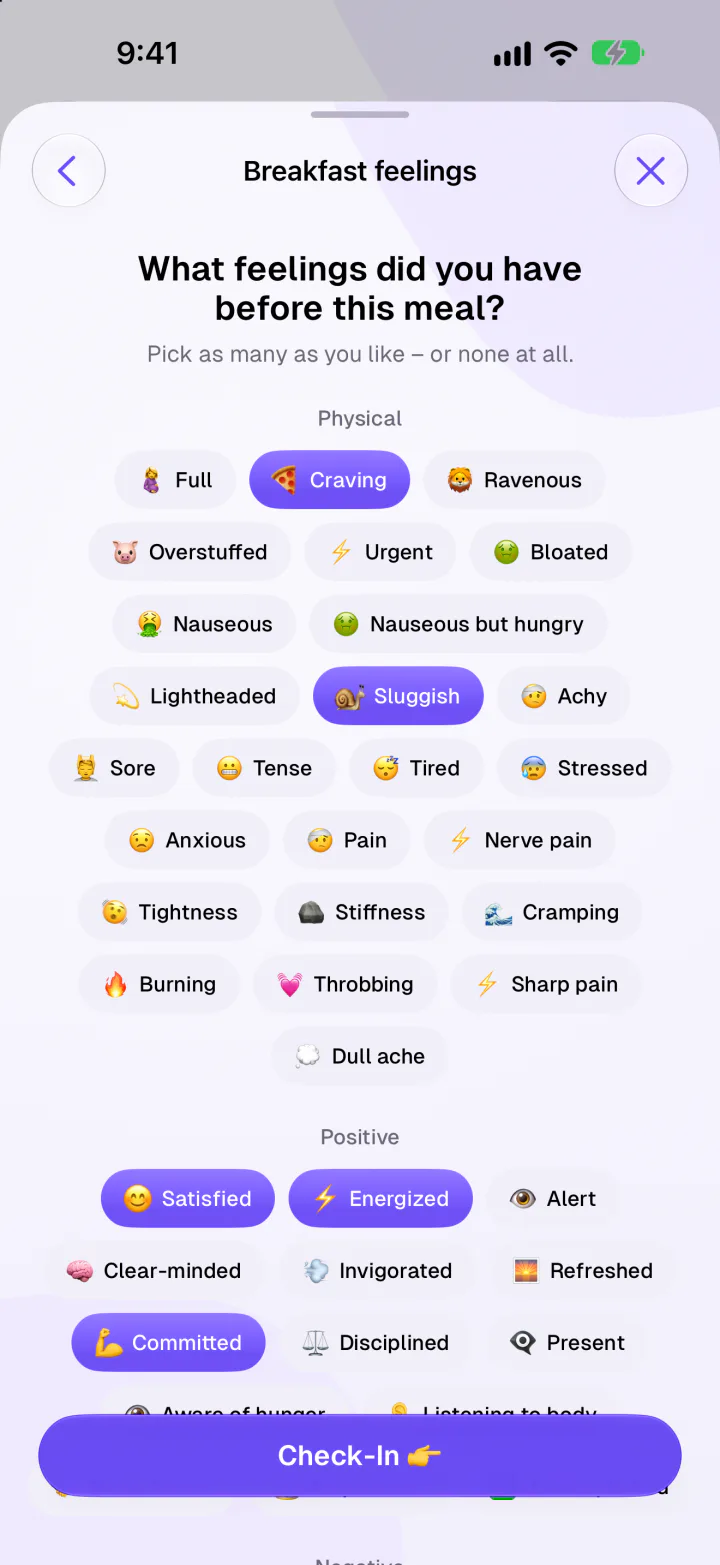
- Hunger types like stress, boredom, social and reward hunger
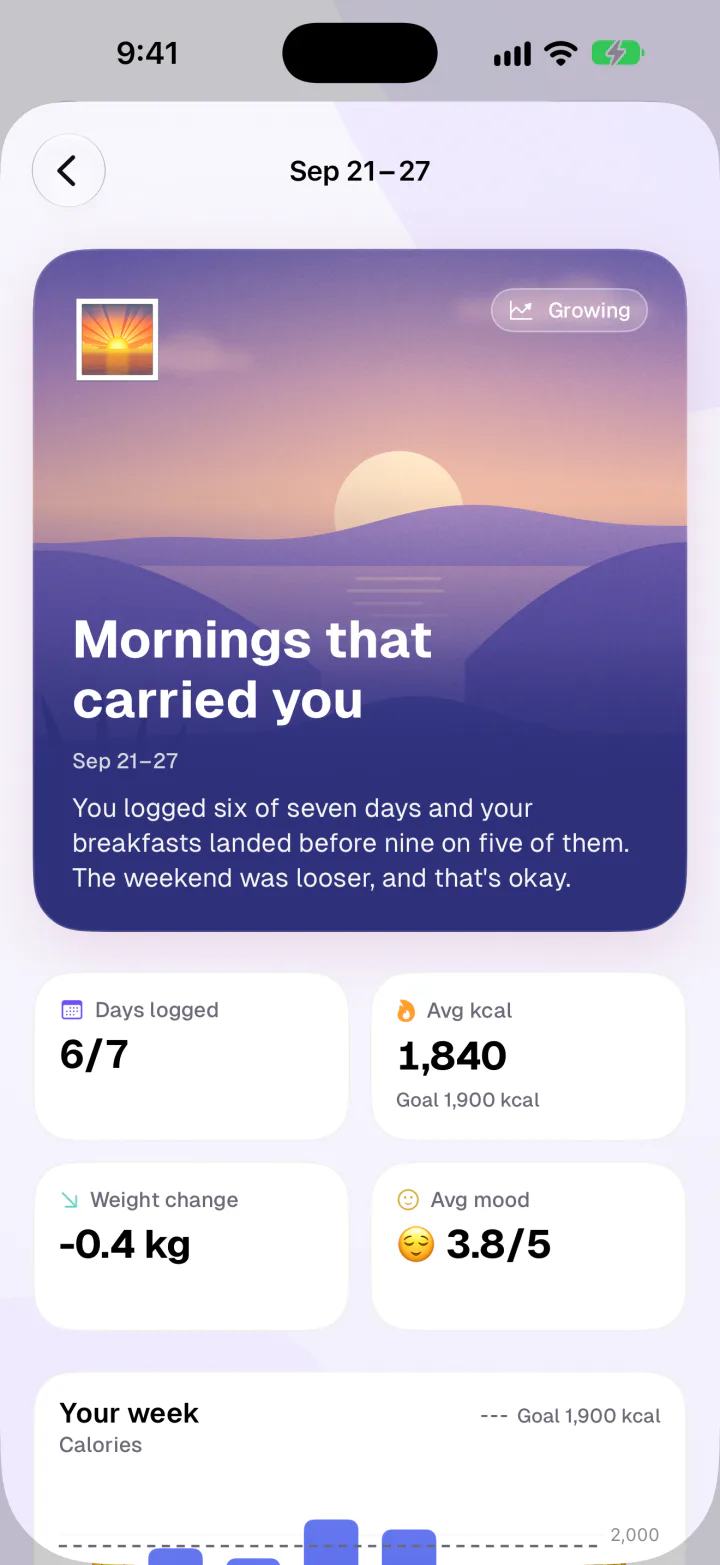
- Your most frequent feelings and hunger trend over time
What to do when the hunger is emotional
The goal isn't to never eat for comfort. It's to have more than one option. Match the response to the feeling:
- StressedFive minutes outside or three slow breaths, then decide. Stress shrinks the gap between urge and action; a short pause widens it again.
- BoredChange the scene. Stand up, refill your water, switch tasks. Boredom hunger often fades once your attention has somewhere else to go.
- LonelySend one message or make a quick call. Connection is what you're actually short of, and food can't fill that gap for long.
- TiredRest if you can, or at least have a glass of water and some daylight. Tiredness is easily mistaken for hunger.
- CelebratingChoose the treat on purpose, sit down and enjoy every bite. Pleasure is a perfectly good reason to eat.
- RushedPut it on a plate and sit for five minutes. Eating on the move makes it hard to notice when you've had enough.
Sometimes the answer is still food, and that's okay. Eating a biscuit because you had a rough day doesn't undo anything. What matters is that it's a choice, not autopilot, and that you can enjoy it without a side of guilt.
Why noticing works better than willpower
Willpower treats emotional eating as a battle. Noticing treats it as a pattern, and patterns can change. The research points the same way. A systematic review of 14 studies found mindfulness-based approaches effectively reduced binge eating and emotional eating.3 A later review concluded they're most effective for exactly the kinds of eating covered here: emotional and external-cue eating.4
To be clear about the limits: the evidence for mindfulness as a weight-loss tool is mixed, and it isn't clearly better than other psychological therapies.4, 5 What it does well is help you understand why you eat, which is where lasting change starts.
That's also why one of the most common practical recommendations is a food diary that records not just what you ate, but how hungry you were and how you felt.1 After two or three weeks, triggers tend to jump out: the late Thursday meetings, the evenings alone, the afternoons after a short night.
Tools that help you notice, compared
You can do this with a pen and paper. The question is which tool you'll actually keep using, and whether it shows you the patterns or leaves you to dig for them.
| What it does | Paper journal | Notes app | Mood tracker | Calorie counter | Built for thisFimbl |
|---|---|---|---|---|---|
| Records what you ate | By hand | By hand | Search, barcode | Search, barcode, photo | |
| Hunger and feelings at each meal | If you remember | If you remember | Daily mood only | Rarely | Guided, in seconds |
| Shows patterns over time | You dig | You dig | Mood only | Totals only | Hunger trend, feelings, weekly reflections |
| Gentle reminders | Usually | Usually | At times you choose |
General categories, not specific products. Many calorie counters don't ask about feelings at all; see our app comparison for details.
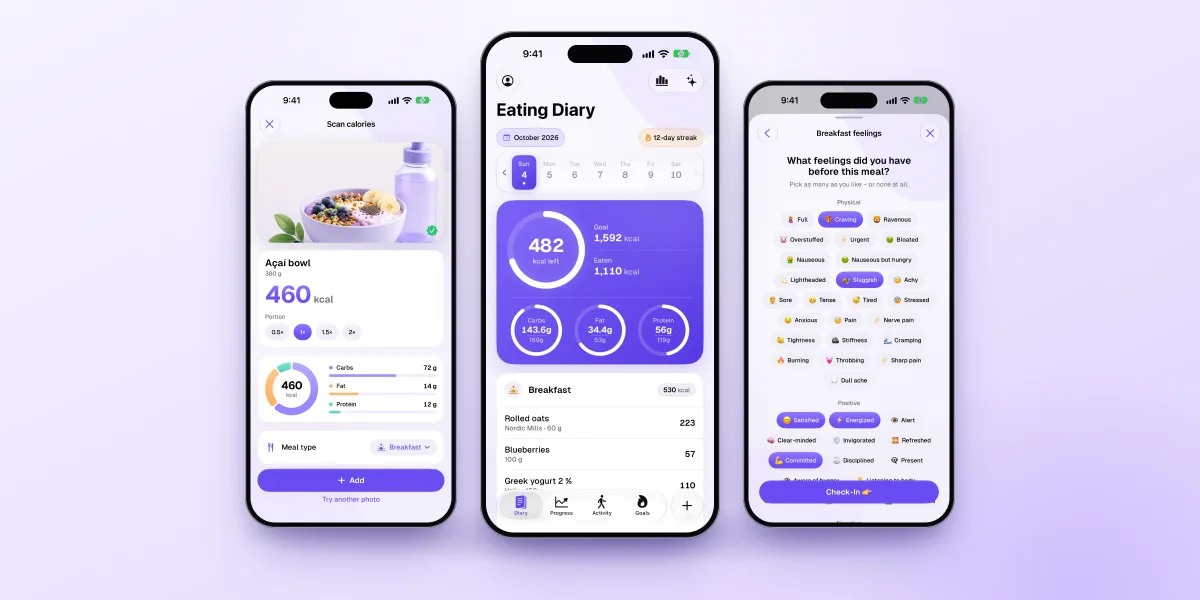
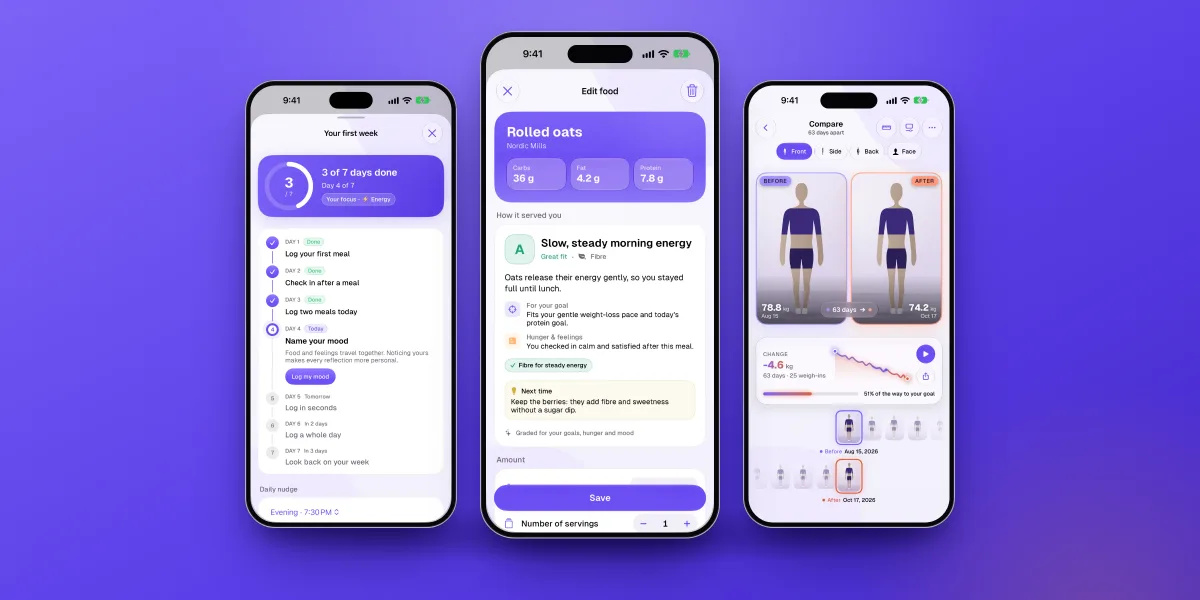
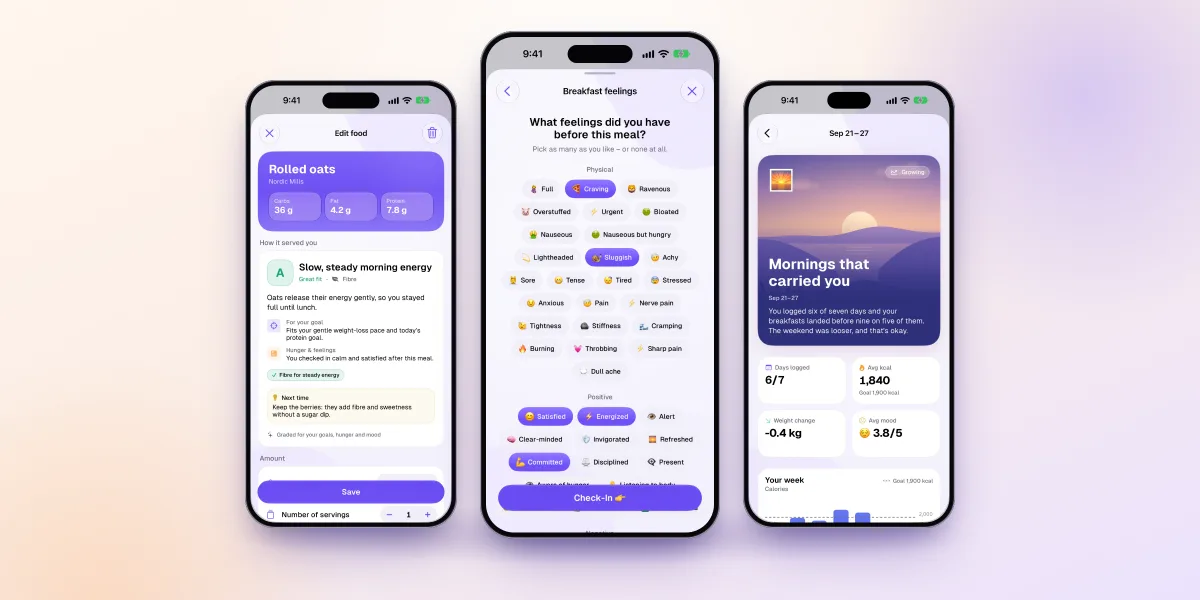
We built Fimbl because we couldn't find a tool that put the food and the feeling in the same place without turning it into homework. The check-in is free, and with Premium a weekly reflection points out the patterns for you, in plain, kind language.
When to get support
Emotional eating is common. Feeling out of control around food is something you deserve help with. Talk to a doctor if you often eat large amounts while feeling unable to stop, eat in secret, try to make up for eating (by vomiting, fasting or over-exercising), or if food and weight take up most of your thoughts.
Free, confidential support: UK Beat helpline (England 0808 801 0677). US ANAD helpline 1-888-375-7767. Finland SYLI support line 02 251 9207. Germany BIÖG counselling 0221 892031. If you're in crisis, call your local emergency number.7–10
Fimbl is a food diary, not a medical tool or a treatment for eating disorders.
For most of us, though, emotional hunger is simply part of being human. The aim isn't to eliminate it. It's to notice it, understand what it's telling you, and answer it with a little more choice. If you'd like a diary that helps with exactly that, you can read why we built Fimbl or start with one check-in today.
Questions, answered
How do I know if I'm really hungry?
Physical hunger builds gradually and shows up in your body: a rumbling stomach, low energy or trouble concentrating, usually a few hours after your last meal. It's open to many foods and can wait a little. If you ate recently, your stomach is quiet and you want one specific food right now, the urge is more likely emotional.
Is emotional eating bad?
No. Eating for comfort or celebration now and then is a normal part of life. It becomes worth looking at when food is your main way of coping with feelings, or when it leaves you feeling guilty or out of control.
Why do I crave sweets when I'm stressed or tired?
Sweet, salty and crunchy foods change how you feel quickly and reliably, so it's easy to learn to reach for them when you're stressed, bored or tired. That's a habit, not a character flaw. Noticing the pattern, for example with a short check-in before you eat, is the first step to choosing on purpose.
What does HALT stand for?
HALT stands for hungry, angry, lonely, tired. It's a long-standing slogan from addiction-recovery communities, and it works well as a quick check before you eat: if you're angry, lonely or tired rather than hungry, food may not be what you need most.
What's the difference between emotional eating and binge eating?
Emotional eating is common and broad: eating in response to feelings rather than hunger. Binge eating disorder is a clinical condition with recurring episodes of eating a large amount while feeling a loss of control, often followed by distress. If that sounds familiar, please talk to a doctor or an eating-disorder service.
Can an app help with emotional eating?
An app can help you notice. Recording how hungry you are and how you feel when you eat is one of the most common recommendations for understanding emotional eating, and Fimbl's meal check-ins are built for exactly that. An app isn't a treatment, though, and it's no substitute for professional help when eating feels out of control.
Sources
- Mayo Clinic. Weight loss: gain control of emotional eating. mayoclinic.org
- NHS Grampian, Healthy Weight. What is emotional eating? healthyweightgrampian.scot.nhs.uk
- Katterman SN et al. (2014). Systematic review of mindfulness meditation for binge eating, emotional eating and weight loss. Eating Behaviors 15(2). pubmed.ncbi.nlm.nih.gov
- Warren JM, Smith N, Ashwell M (2017). Review of mindfulness and mindful eating and their effects on eating behaviour. Nutrition Research Reviews 30(2). pubmed.ncbi.nlm.nih.gov
- Liu J et al. (2025). Meta-analysis of mindfulness-based interventions for eating behaviour. Journal of Behavioral Medicine 48(1). pubmed.ncbi.nlm.nih.gov
- Kretchman D (2026). On the origins and use of the HALT slogan in recovery. Advances in Drug and Alcohol Research 5. doi.org
- Beat, the UK's eating disorder charity: helplines. beateatingdisorders.org.uk
- ANAD eating disorders helpline (US). anad.org
- Syömishäiriöliitto SYLI ry (Finland). syomishairioliitto.fi
- BIÖG telephone counselling on eating disorders (Germany). essstoerungen.bioeg.de