Calorie tracking8 min read
How accurate is AI calorie tracking, and does it matter?
AI photo estimates are rough, and the research says so. But so is every other way of logging food. Here's what the studies found, why ease beats precision for most people, and when to reach for a barcode instead.
On this page
Point your phone at a bowl of pasta and an app tells you 640 calories. It sounds precise. It isn't, quite. But here's the thing nobody selling AI trackers likes to say out loud, and nobody criticising them mentions either: the old way was never precise. The real question isn't whether AI is exact. It's whether it helps you keep going.
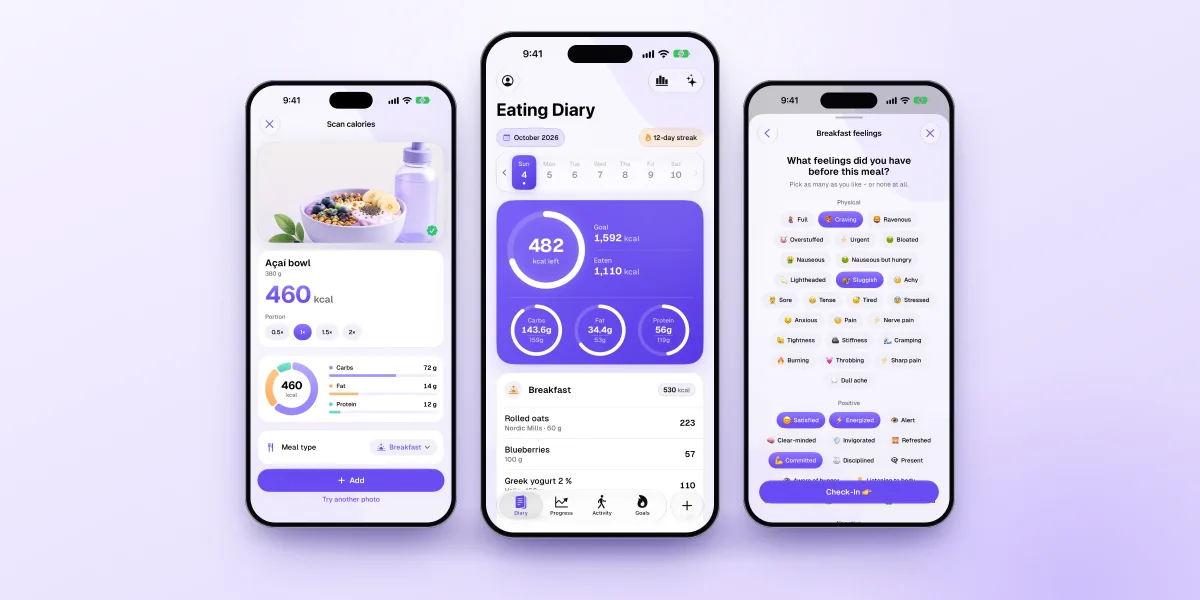
AI photo calorie estimates are rough: in a 2025 study, the best general-purpose AI models were off by about 36% per photo on average, and tended to underestimate large portions.1 That sounds bad until you compare it with the alternative. The same researchers found AI performed comparably to traditional self-reported methods, without the effort.
- Use AI for ease: home-cooked plates, restaurant meals and anything without a label. A rough log beats no log.
- Use the database for precision: scan a barcode on packaged food and you get the manufacturer's own label values.
- Correct once, reuse forever: adjust an estimate, save the meal, and the next log is one tap and spot on.
How accurate is AI calorie counting?
The most useful recent study tested three widely used general-purpose AI models on 52 standardised food photos, from single ingredients to complete meals in three portion sizes, and compared their answers with weighed reference values.1
- About 36% off on averageThe two best models missed the energy content of a photo by around 36% on average. The third did noticeably worse.
- Big plates get underestimatedAll three models underestimated more as portions grew. A generous serving is where AI is least reliable.
- Comparable to food diariesThe authors concluded the best models performed comparably to traditional self-reported methods, without the user burden.
- Not for clinical precisionThey also said general-purpose AI isn't yet suitable for precise dietary assessment in clinical or athletic settings.
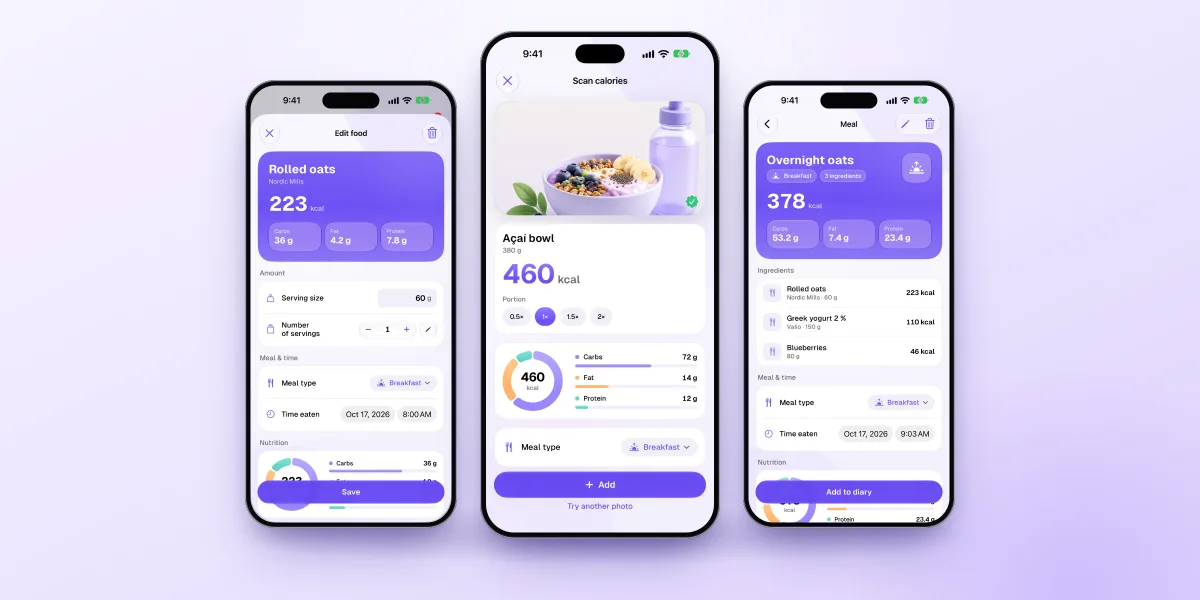
Two caveats run in opposite directions. The study used 2024-era models, and the field moves fast, so today's estimates are likely better. On the other hand, real-life photos are messier than lab photos. A second 2025 study with a newer model shows what helps most: the average calorie error was about 31% from the photo alone, 24% when a few words about the meal were added, and 14% with a list of ingredients.2 That's why the best AI logging lets you say what's in the dish, not just snap it.
Manual logging was never exact either
It's tempting to compare AI with a perfect, weighed, lab-measured diary. Nobody keeps that diary. Real food logging is guesswork too, and the guesses lean one way.
| Where errors come from | Writing it down | Database search | AI photo scan | Most preciseBarcode scan |
|---|---|---|---|---|
| Portion size | You guess | You guess | AI guesses | You choose servings, the label does the rest |
| Nutrition values | You guess or look up | Depends on the entry you pick | AI estimates | The manufacturer's label |
| Forgotten items | Common: snacks, drinks, oil | Common | Less common: it's all in the photo | Only what you scan |
| Effort per meal | High | Medium | Lowest | Low |
Even labels have a margin: EU rules allow declared protein, carbohydrate and fat to differ from lab measurements by up to 20% for many foods, because ingredients vary from batch to batch.4
Research on self-reported eating is sobering. A review of traditional dietary records found people consistently report eating less than they actually do, and the gap grows with body weight.3 In one classic study, a group of people who believed they couldn't lose weight on a diet were underreporting their food by almost half.5 No one was lying. Remembering, estimating and writing down every bite is simply hard.
So the choice isn't between AI and accuracy. It's between different kinds of rough, and the one that matters most is the one that keeps you logging.
Why "close enough" works
A food diary is useful because of the patterns it shows over weeks, not because any single meal is perfect. Research on logging points the same way: in one study, how often people logged was linked with weight loss, while how long they spent logging was not.6 Precision that costs you three minutes a meal is precision you'll give up by Thursday.
A rough log you keep for three months tells you more than a perfect one you abandon in a week.
Errors also matter less than they look, because they tend to be consistent. If AI reads your usual breakfast low every time, your trend is still accurate: you'll still see that weekdays look different from weekends, and that the evening snack grew in November. And for the things where precision matters, you have a better tool.
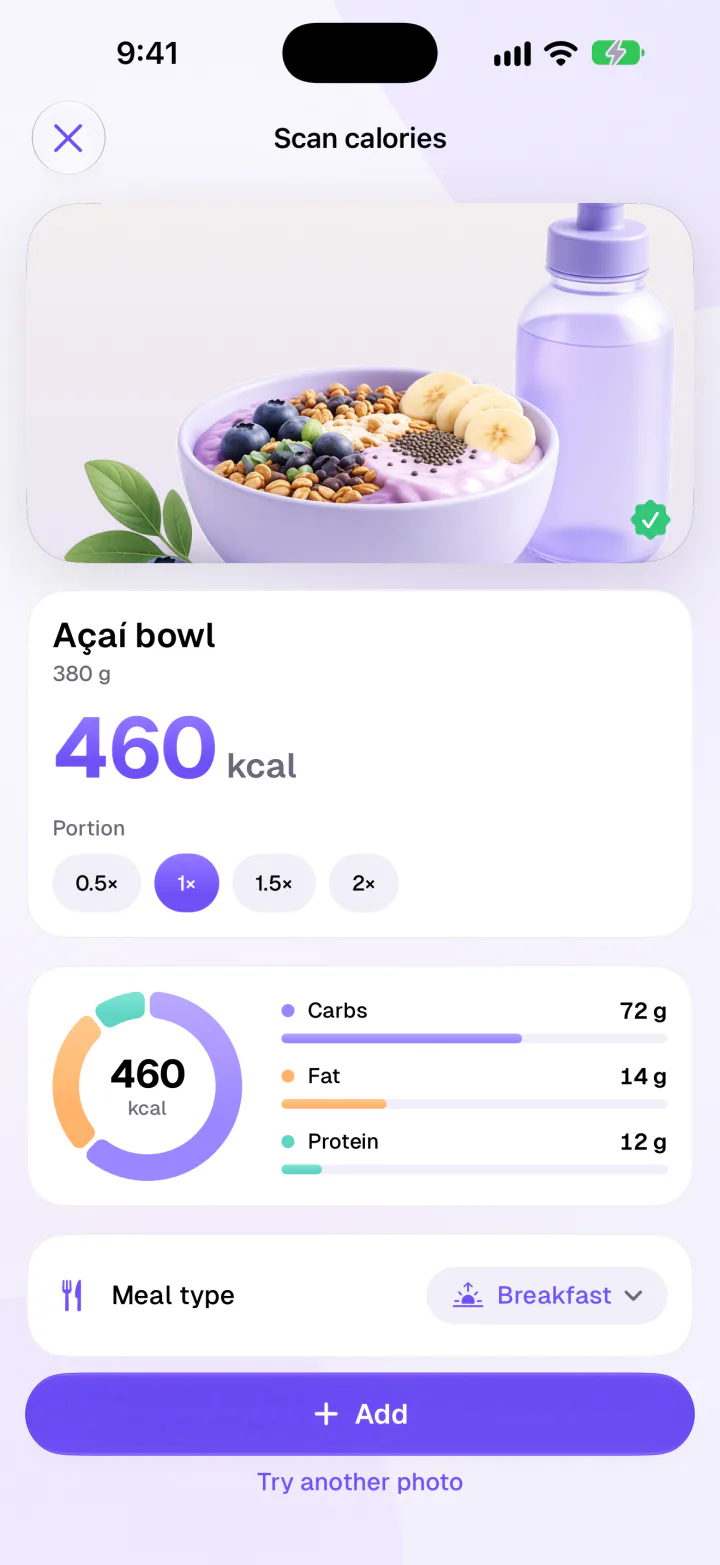
- Photo scan, text or voice, and nutrition label scan
- Recipes from Reels, TikToks, YouTube Shorts and recipe sites
When to skip AI: the product database
For anything that comes in a package, you don't need an estimate. The nutrition is printed right there, and a barcode gets it into your diary in a second. Fimbl's food catalogue is built from:
- Packaged products by barcodeFrom Open Food Facts, the open worldwide database of food labels, with each product's own nutrition values.7
- Everyday whole foodsGeneric foods from Fineli, the Finnish national food composition database, and USDA FoodData Central.8, 9
- Products people addMissing a product? Add it once from its label, and it's there the next time you scan it.
-
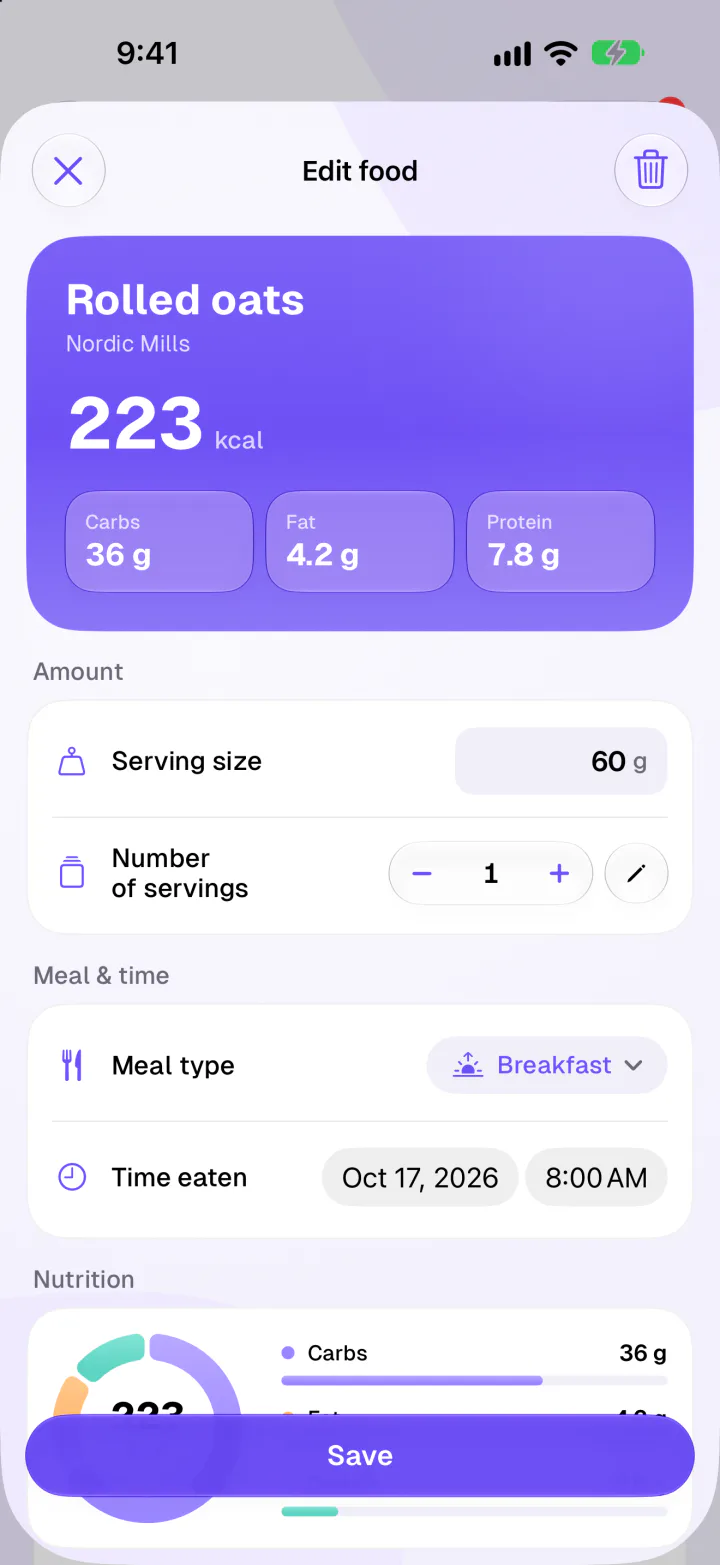
Label values, not guessesScan or search a product and adjust the serving. Barcode scanning is free in Fimbl.
-
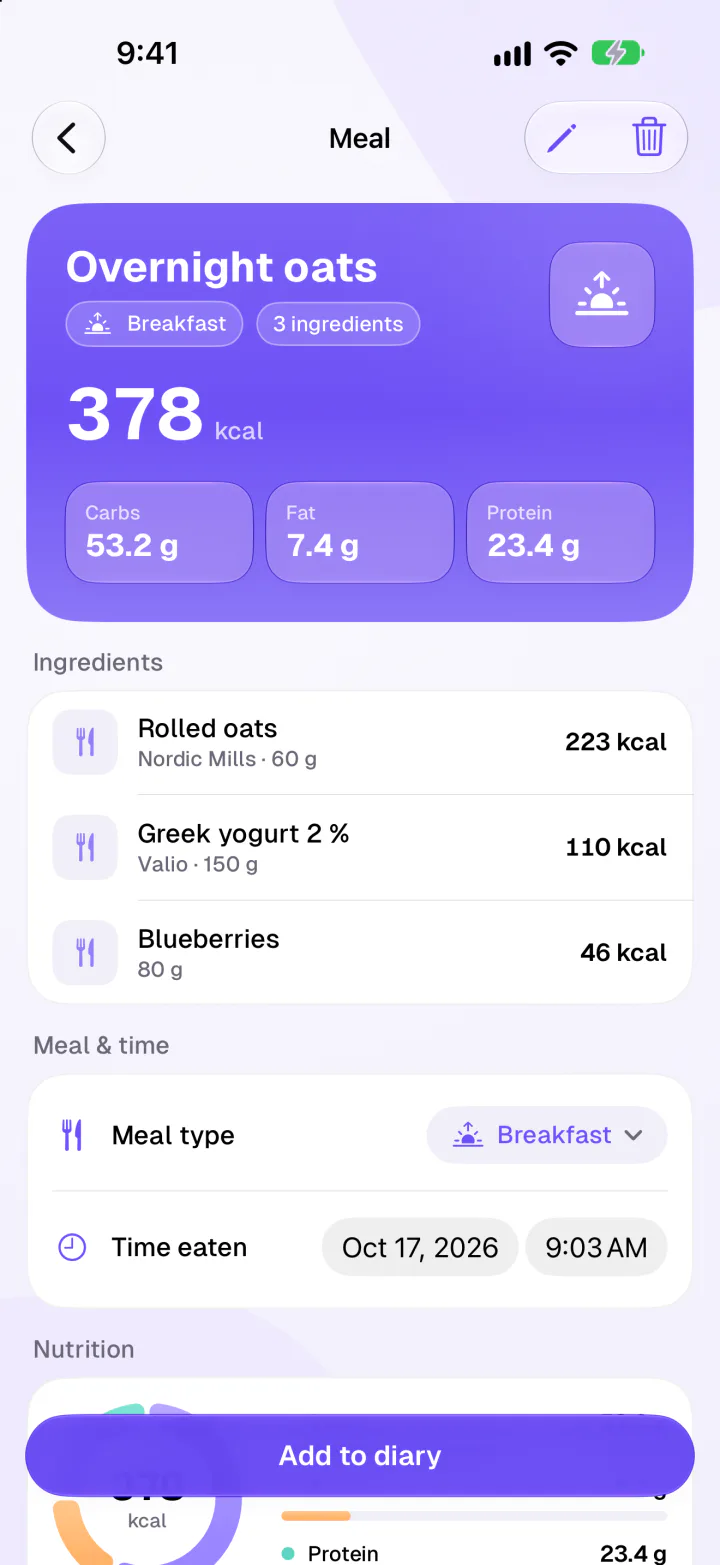
Precise once, quick foreverBuild a regular meal from real products, save it, and log it again with one tap.
Which method to use when
Reach for the database
- Packaged food
- Yogurt, cereal, bread, ready meals: scan the barcode.
- Meals you eat often
- Build them once from real products and save them.
- When precision matters
- Specific macro targets, or a plan from your dietitian.
Let AI handle it
- Restaurant and takeaway
- No label, no recipe, just a plate.
- Home-cooked mixed dishes
- Stews, salads and bowls that would take ten entries by hand.
- Busy moments
- When the choice is a photo or nothing, take the photo.
And when you have neither the time nor the energy, a quick add of a rough calorie number keeps the day in your diary. Close enough is good enough. The tracker that wins is the one you keep opening, which is the same conclusion we reached in our calorie tracker comparison.
Five ways to get better AI estimates
- Get the whole plate in the frame. Shoot from slightly above so the AI can see depth as well as area. Half a plate means half an estimate.
- Say what the camera can't see. Oil, butter, dressing, sugar in the coffee. Hidden fats are the most common blind spot, and describing them is the single biggest improvement.
- Check the portion, not just the food. AI tends to underestimate big servings. If you had seconds, bump the portion up.
- Split meals with packaged parts. Scan the yogurt's barcode, photograph the fruit on top. Each tool where it's strongest.
- Fix it once, then save it. If you eat a dish regularly, correct the estimate and save it as a meal. Your next log is one tap and exactly right.
What happens to your food photo?
Before you point any app at your plate, it's worth asking where the picture goes. Ask of every AI tracker: is AI optional, what exactly is sent, is it linked to your name, and is it used to train models?
In Fimbl, AI is optional and Premium-only. When you use a scan, the photo goes through Fimbl's servers to Google's Gemini API, without your name or email. We don't use your data to train AI models. Free accounts never send anything to an AI service, and the diary, search and barcode scanning work fully without AI. Our privacy policy explains each feature in detail.
AI when it's easier, labels when it matters
Fimbl's free diary gives you barcode scanning, search and saved meals. Premium adds photo, voice and text logging for the meals that don't come with a label. You choose, meal by meal.
- Free barcode scanner, no ads
- Photo, voice and text logging with Premium
- Every estimate adjustable
Questions, answered
How accurate are AI calorie counting apps?
Roughly accurate, not exact. In a 2025 study of 52 food photos, the best general-purpose AI models missed the calories by about 36% on average, and underestimated large portions more. Adding a short description or ingredient list improves estimates considerably. The researchers judged the best models comparable to traditional self-reported food diaries.
Is AI calorie tracking more accurate than logging manually?
Not necessarily more accurate, but not much worse either, and far less effort. Manual food diaries are also prone to error: people consistently report eating less than they actually do. For packaged foods, scanning a barcode beats both, because it uses the manufacturer's label values.
Does it matter if my calorie tracker isn't 100% accurate?
Usually not much. A food diary is useful for the patterns it shows over weeks, and errors tend to be consistent from day to day, so trends stay meaningful. Research links logging often with better results more than logging precisely. If you need precision for a medical or athletic goal, use barcode scanning and weighed portions.
How can I get better calorie estimates from a food photo?
Get the whole plate in the frame from slightly above, mention anything the camera can't see such as oil, butter or dressing, check the portion size, scan the barcodes of packaged parts separately, and save corrected meals so you can re-log them exactly.
Where does Fimbl's food data come from?
Packaged products come from Open Food Facts, the open worldwide database of food labels, so a barcode scan gives you the product's own nutrition values. Generic foods come from Fineli, the Finnish national food composition database, and USDA FoodData Central. Users can add missing products from the label.
Does Fimbl send my food photos to AI?
Only if you use an AI feature, which is optional and part of Fimbl Premium. The photo goes through Fimbl's servers to Google's Gemini API without your name or email, and it isn't used to train AI models. Free accounts never send anything to an AI service.
Sources
- Fridolfsson J, Sjöberg E, Thiwång M et al. (2025). Performance evaluation of 3 large language models for nutritional content estimation from food images. Current Developments in Nutrition 9(10). pubmed.ncbi.nlm.nih.gov
- Rodríguez-Jiménez M et al. (2025). Image-based dietary energy and macronutrients estimation with ChatGPT-5: cross-source evaluation across escalating context scenarios. Nutrients 17(22). pubmed.ncbi.nlm.nih.gov
- Ravelli MN, Schoeller DA (2020). Traditional self-reported dietary instruments are prone to inaccuracies and new approaches are needed. Frontiers in Nutrition 7. pubmed.ncbi.nlm.nih.gov
- European Commission (2012). Guidance document for competent authorities for the control of compliance with EU legislation with regard to the setting of tolerances for nutrient values declared on a label. food.ec.europa.eu
- Lichtman SW et al. (1992). Discrepancy between self-reported and actual caloric intake and exercise in obese subjects. New England Journal of Medicine 327(27). pubmed.ncbi.nlm.nih.gov
- Harvey J et al. (2019). Log often, lose more: electronic dietary self-monitoring for weight loss. Obesity 27(3). pubmed.ncbi.nlm.nih.gov
- Open Food Facts: the free and open food products database. world.openfoodfacts.org
- Fineli, the national food composition database in Finland. Finnish Institute for Health and Welfare. fineli.fi
- USDA FoodData Central. fdc.nal.usda.gov